Showing posts with label Paper Writing. Show all posts

2026/04/29

Essay Writing Format: The Complete Guide to Structure, Style, and Academic Success

Essay writing format is one of the most important skills you must build.

No matter if you are a college junior struggling to write a 20+-page research paper or a high school student writing their first five-paragraph essay, writing format is important for everyone.

A strong format gives your thinking a way to deliver it on paper.

It tells your professor that you know how to organize essay ideas, build arguments, and communicate authority.

Essay Writing Format: The Complete Guide to Structure, Style, and Academic Success: eAskme

Other people are reading: How Early Assumptions Shape Pedestrian Accident Cases More Than Evidence Itself in Pensacola, FL

Today, I am sharing everything you must know about essay formatting, structural skeleton, academic style rules, assignment types, paragraph-level mechanics, and format variations.

You will learn:

  • What Is Essay Writing Format?
  • Standard Academic Formatting Guidelines
  • Citation Styles: MLA, APA, and Chicago
  • Essay Format by Type
  • Common Essay Formatting Mistakes to Avoid
  • Essay Format Checklist

By the end of this article, you will have an actionable blueprint to apply to an essay.

Essay Writing Format:

Essay writing format is the set of stylistic and structural implementations that impact how an essay is presented and organized.

It covers two dimensions:

  • Structural format: How ideas are arranged, such as introduction, body, and conclusion.
  • Visual format: How the essay looks on the page, such as fonts, space, margins, and citations.

Both dimensions matter for an excellent essay format. A brilliant essay in a nonstandard or cluttered format lost its value.

At the same time, a perfectly formatted article with no real value also fails. The end goal is to master both dimensions to present your idea in the best possible way.

The Three-Part Essay Structure:

The modern essay standard follows the three-part structure:

  • Introduction
  • Body
  • Conclusion

This format reflects how arguments are processed in different parts. It is necessary to explain what the audience is going to hear, hear it, and finally what they heard.

Here is the detailed breakdown of the essay structure:

The Introduction:

The introduction is where you leave the first impression. It can be one or two paragraphs long. You cover three things: hook, context, and thesis statement.

The Hook:

The hook is your opening sentence. It earns the reader’s attention before he commits to reading the whole essay.

Here are the categories of the effective hook:

  • Startling statistic: Add stats like reports, percentages, or numbers from the research document.
  • Provocative question: Ask like “if you have ever made this decision?”
  • Vivid anecdote: Write a brief story illustrating the stakes of the topic.
  • Bold declarative statement: Make a surprising or counterintuitive claim.
  • Relevant quotation: add a line from credible sources.

Note: Avoid generic openers like people have always, or throughout history, or dictionary defines.

Background Information:

After the hook, add two or four lines related to your header. Define key terms, scope, and historical context. It connects the hook with the thesis.

Do not over-explain everything. It is just the body of your main content.

The Thesis Statement:

It is one of the most important parts of the introduction. It explains what your reader can expect from your essay.

A thesis should be:

  • Specific: Example, prolonged use of TikTok and its impacts.
  • Arguable: Claims that someone could disagree.
  • Position: Position the last sentence of your introduction correctly.
  • Proportional: keep it concise for a short essay and complex for a long essay.

Weak thesis: Example is Climate change is a serious problem."

Strong thesis: An example is that without bending federal carbon emissions, corporate self-regulation will remain insufficient.

The thesis should make a claim and provide reasoning.

Body Paragraphs:

Body paragraphs are where arguments live. It proves your thesis. Make sure that each of your body paragraphs contains a unit of argument.

Introduce the main point, support with evidence, explain the evidence, and move to the next point.

Five-paragraph essays often have three body paragraphs. Research papers and analytical essays can have up to 10 or more paragraphs.

The Topic Sentence:

The topic sentence is in the paragraph about the thesis of the essay. It announces the paragraph claim.

A strong topic sentence covers three things:

  • Introduction to the paragraph's main point
  • Connects that point back to the thesis
  • Establishes a logical position in the essay's overall argument

Example: “The most damaging effects of social media on teens' mental health are disruption of sleep patterns.”

This line tells the readers what the paragraph is about.

Supporting Evidence:

After the topic sentence, add supporting evidence.

You can include:

  • Statistics and data
  • Direct quotes from credible experts
  • Case studies or examples
  • Historical precedents

In academic essay writing, it is a must to cite evidence. Uncited claims are often at risk of plagiarism and carry no academic weight.

Also, add an explanation to your evidence.

Analysis and Warrant:

It is the most common section that essay writers skip.

It separates paper A from paper B.

After explaining the evidence, you must prove how it connects with your thesis.

Ask yourself:

  • So what?
  • Why does this evidence matter?
  • What does it prove?
After that, write the answer.

Example: “Research suggests that social media algorithms eliminate the psychological buffer zone between daily stress and sleep onset.”

This analysis connects dots and builds connections.

Transition Sentences:

End body paragraph with a sentence to summarize the contribution or bridge to the next point. A smooth and strong transition is necessary.

Topic jumps signal a disorganized essay.

Weak transition example: “I will talk about social comparison.”

Strong transition example: “disturbed sleep patterns cause psychological harm. The psychological toll of social comparison presents a threat to adolescent well-being.”

The Conclusion:

The Conclusion is the third part of the essay structure.

It is not a summary, but it works as a synthesis. Where a summary only explains what was said, synthesis displays how the essay parts connect to reveal something.

Restate the Thesis:

Revisit your thesis without repeating it.

Use different words and phrases. Restate the claim with depth, acknowledging the fact that your reader has understood everything.

Original thesis example: Prolonged use of TikTok contributes to increased anxiety in adolescents.”
Restated in conclusion: The evidence makes it clear that TikTok’s design systematically erodes adolescent mental health.

Synthesize Key Points:

Touch every major argument in conclusion. Do not repeat them. Use two or three sentences. Do not add any new evidence to this part.

The Closing Statement:

End the sentence with options like:

  • A call to action
  • A broader implication
  • A return to the hook
  • A forward-looking statement

Citation Styles:

The citation style changes according to the institution and discipline.

Here are the 3 major citation formats:

MLA Format (Modern Language Association):

MLA format is widely used in English, literature, and the humanities. It uses the author’s last name and page number cited at the end of the page. 

APA Format (American Psychological Association):

APA format is used in psychology, social sciences, education, and nursing.

It uses the author's name and year. You can find it at the end of the reference pages. It requires a title page.

Chicago/Turabian Format:

It is used in history, arts, and philosophy.

You can find it in either footnotes or endnotes. It displays the author and date in citations.

Before writing, make sure you know which format your instructor requires.

Essay Writing Format by Type:

Essay Writing Format types: eAskme

Different essay types have the same basic structure.

Argumentative Essay Writing Format:

Argumentative essay format is one of the most common types of essay format. It uses a strong thesis and debatable claims.

In the body part, you can present evidence and counterarguments. This type of essay format acknowledges the opposition’s point of view systematically. 

Analytical Essay Writing Format:

It is a common type of essay format in history and literature courses.

It does not argue about position. You share how historical events unfold, create meaningful text, and achieve goals.

Close reading of the primary source discloses evidence.

Expository Essay Writing Format:

Expository essay format informs or explains without taking a personal side. It is common in introductory courses, science writing, and journalism.

You should focus on accuracy and clarity.

Narrative Essay Writing Format:

The narrative essay format is popular in colleges for creative and application writing.

It tells a story with clear insight. It also requires a thesis with a flexible structure.

Compare and Contrast Essay Writing Format:

It is the type where you compare two or more subjects. It can follow a point-by-point structure or a block structure.

Common Essay Formatting Mistakes:

Formatting errors are common in essay writing. But this mistake can cost grades.

Here are the most common essay formatting mistakes to avoid.

  1. Padding the introduction: Do not begin your essay with broad, vague statements. It just wastes the reader's time.
  2. Conclusion as a summary: Do not restate every paragraph's point.
  3. Orphaned evidence: Do not drop a quote or statistic into a paragraph without analysis. Always introduce and analyze every piece of evidence.
  4. One-sentence paragraphs: Write each paragraph with usually 4–8 sentences.
  5. Ignoring the word count: Do not write under or over the assigned word count.
  6. Informal language: Do not use contractions, slang, and first-person overuse.
  7. Inconsistent citation: Do not mix MLA and APA styles.

Essay Writing Format Checklist:

  • Before submitting your essay, go through this checklist:
  • Introduction contains a hook, background context, and a clear thesis statement
  • Each body paragraph opens with a topic sentence tied to the thesis
  • Every piece of evidence should have an analysis
  • Paragraphs end with a transition
  • Conclusion restates the thesis, synthesizes key points, and ends with a meaningful closing.
  • Font is Times New Roman 12pt
  • Spacing is double throughout
  • Margins are 1 inch on all sides
  • All sources are cited correctly in the required format
  • No new evidence or arguments appear in the conclusion

Standard Academic Formatting Guidelines:

Academic essays should follow the visual formatting standards.

Formatting Element Standard Specification
Font Times New Roman, 12-point; or Arial/Calibri 11pt
Line Spacing Double-spaced, block quotes and references
Margins 1 inch all four sides
Paragraph Alignment Left-aligned
Paragraph Indentation 0.5-inch first-line
Page Numbers Required
Header/Title Varies by style

Conclusion:

The essay writing format guide explains the three-part format, including the introduction, body, and conclusion.

It is necessary to endure this style. It forces essay writers to define arguments before making them.

Writers must provide evidence and reflect on implications.

Essay format is a tool. The best academic writers understand and follow rules. An excellent writer can go forth and backwards to depart from the set standards.

Master these essay writing formats.

FAQs:

How long should an essay introduction be?

A 5-paragraph essay should have 4 to 7 sentences, and a long research paper should have one or two paragraphs.

How many body paragraphs does an essay need?

The minimum number is 3 for a standard essay. Your number should match the complexity of your essay.

Do all essays need a thesis statement?

Yes.

What's the difference between a topic sentence and a thesis?

Topic sentences cover one paragraph's argument, while the thesis covers the entire essay’s argument.
Can I use first person ("I") in an academic essay?

It depends upon the discipline and assignment. MLA format often chooses the first person.

Should the conclusion introduce new information?

No.

Other helpful articles:

Read More

2026/01/06

11 Vocabulary and Grammar Tips for Better Essay Writing!

Grammar and vocabulary are essential for students as well as professionals. Essay writing cannot be impressive without an influential vocabulary.

Grammatical mistakes also ruin a well-written essay. For quality essay writing, it is necessary to fix grammar and improve vocabulary.

Gaurav once said that grammar suffers at the hands of people because people suffer from grammar.

If you have kids studying in primary schools or kindergarten, then you should follow the Helen Doron program.

But if you are at a level where you need professional and polished grammar, then you should read this guide.

Vocabulary and Grammar Tips for Better Essay Writing: eAskme

Other helpful articles: Enterprise SEO and AI Trends in 2026: To Stay Ahead!

Vocabulary and Grammar Tips for Better Essay Writing:

To improve your grammar and vocabulary, you need to read more, use verbs, learn sentence structure, cut down the passive voice, and proofread essays like an expert.

Here are the tips that will help you improve your vocabulary and grammar.

Improve Vocabulary for Better Essay Writing:

Vocabulary is the database of words in a particular language that is stored in your brain and processed whenever you need it.

Every person perceives words and language in different ways. It is the reason why some people use excellent words while others lack basic English words.

Tips to improve vocabulary for essay writing:

Read:

Reading is the first step to increasing English vocabulary.

The more you read English newspapers, blogs like eAskme, or British magazines, the better your vocabulary becomes.

Your subconscious mind stores words and their usage when you keep on reading the same type of words multiple times.

You can either read a new book every day or buy a newspaper subscription.

Word Journal:

A word journal is helpful for those who are born overseas and study languages other than English.

Non-native English speakers should keep a word journal handy.

Note new words, their definition, and their usage. Now try to use them whenever necessary.

It is best to take help with the word journal if you forget a word or the sentence structure.

Verbs:

In English, each verb has a strong and a weak form to represent it.

For example, went is the weak word. You can replace it with bolted and splinted.

The more you use strong verbs, the better your essay will become. It also helps with assignment writing projects.

Precise:

When writing English, essay writers have the habit of being pretentious.

You need to understand that you need words that fit in the sentence because they should be there, not because you want them to be there.

Be precise when writing an influential essay.

Roots:

To become proficient in English vocabulary, you must learn root words.

Take help from a dictionary or a book written by scholars.

It will help you understand the foundation of vocabulary and improve your essay.

Improve English Grammar for Better Essay Writing:

To write a quality essay in English, you must understand English.

These days, you can also take the help of grammar tools like Grammarly.

Yet, you still need a human eye to find any remaining errors.

Tips to improve grammar for essay writing:

Sentence Structure:

When writing English, follow sentence structure.

Use complex, simple, and compound sentences. It will create engagement and rhythm in your essay.

You should also decide whether you want to follow U.K. style or U.S. style English.

Active Voice:

To make your essay writing impactful, you must always write in the active voice.

It increases the impact and directs your essay’s tone.

In fewer words, you can write an engaging essay.

Filler Words:

Get rid of filler words. It only adds fluff to your essay.

Stop using words like basically.

It works as an unnecessary modification to your sentence structure.

Tense:

In which tense are you writing your essay?

If it is present tense, keep that tense formation throughout the essay.

Avoid shuffling between past and present tense multiple times.

Punctuation:

Punctuation mistakes are common. But you must avoid them.

To write professional and expert-level essays, you must fix all the punctuation errors.

Use colons and semicolons in the right places.

Read Out Loud:

Reading aloud is a habit that helps you catch mistakes and errors in your essay.

You can easily identify phrasing mistakes.

Fix them.

Now you have fixed vocabulary and grammar errors in your essay. The job is not yet completed.

How to Become a Better Essay Writer?

Follow these tips to become a better English essay writer.

You need to outline the essay structure before writing.

Edit and proofread essays at different stages. The more you practice, the better your essay writing will be.

Conclusion:

Now you know the ways to improve your vocabulary and grammar to write better essays; you must practice.

The more you practice, the more you can avoid grammatical mistakes. Learn new words every day, and it will significantly improve your vocabulary. You will become a better essay, resume, and academic paper writer.

Now write the essay and show your expertise.

Other helpful articles:

Read More

2022/11/11

How Essay Writing Skills Can Aid Your Future Career?

Essay writing might not be something a lot of students love to do.

Written college assignments sometimes feel like a chore.

How Essay Writing Skills Can Aid Your Future Career?: eAskme

However, this is an important exercise that prepares one for a future career.

In this guide, you'll learn how these skills can serve you in the long run.

Writing Builds Essential Skills:

In many cases, students might think essays are just annoying tasks that bring little value.

Sometimes it is hard to see how something like that can be applied in real life.

Yet, it offers an opportunity to develop and grow a specific skill set.

For instance, WritePaper writers have shared their opinion on that.

It is a professional academic writing service that helps students with all college papers, from essays to case studies.

Expert authors offer writing, editing, and proofreading help on the shortest notice.

So students that need more time or confidence in their skills can count on professional assistance and guidance anytime.

This type of work requires advanced skills and deep knowledge of the field.

Based on first-hand experience, writers shared the list of competencies essay writing helps build, namely:

  • Research;
  • Analytical thinking;
  • Critical thinking;
  • Communication;
  • Persuasion;
  • Creativity;
  • A structured approach to sharing ideas;
  • Attention to detail;
  • Ability to base opinion on facts and data;
  • General verbal intelligence.

And those competencies are necessary for almost any job, whether you are looking into a writing career or not.

Whether you are aiming to become a game developer, nurse, or marketing manager, you will need them in some way.

How Essay Writing Can Aid Your Career?

Getting a Job:

When looking for a job, writing is usually the one thing that ensures a good first impression on a recruiter.

It all starts with a resume and cover letter.

Recruiters often spend 10-20 seconds scamming through the application.

And it is crucial to stand out and grab their attention.

Crafting a winning resume takes a lot of skill and effort.

One must focus on the essential factors, keywords, and the posting itself.

It has to be structured, precise, and impressive.

This is what essay writing can teach one indirectly.

It is all about gathering information, understanding the prompt, and laying out the argument logically.

One can analyze the job posting, see what competencies the employer is looking for, and cater to those in a cover letter or resume.

Communication in the Workplace:

In the modern world, the majority of communication is written.

Even if you are a web developer, chances are you are going to exchange a lot of ideas in some of these forms:

  • Emails;
  • Texts;
  • Memorandums;
  • Presentations;
  • Social media platforms;
  • Proposals, etc.

They all require precision, attention to detail, and focus on the reader.

Many issues appear from miscommunications and the inability to formulate the prompt or idea.

Here is where college essays come in handy.

They teach to understand the target audience and formulate the main idea of a text (thesis statement).

After that, one must cohesively uncover it and present supporting arguments or evidence to persuade, inform or compare.

Quality Networking:

The ability to present your ideas clearly, as well as excellent grammar, represents your professionalism.

They also add to the company's reputation.

This is a perfect opportunity to maximize your potential and showcase your strengths.

Imagine you receive a proposal with a lot of errors and grammar mistakes.

Would you trust such a person to represent your interests or do your project?

It isn't definite.

Lack of communication skills and attention to detail can damage one's reputation.

But with excellence comes quality networking.

You get to impress potential clients, partners, and end customers. This is important to grow as a professional and achieve your career goals.

It can also help increase sales, attract new vendors, or become a valuable part of the company.

Formal Tone:

Another essential feature essays can teach is formal tone and courtesy.

They are necessary for business communication. It is considered respectful hence any specialist needs to master it.

Sure, some industries might rely less on formal tone.

But it is an excellent competency to obtain nevertheless.

This is particularly helpful to lawyers, entrepreneurs, government officials, medical professionals, marketers, etc.

Fact-Checking and Research:

Almost any college essay relies on quality research.

One must build a strong case with a background understanding of the context and strong arguments.

This skill is also crucial for your future career.

Fact-checking can make or break the deal. It ensures credibility, trust, and clear communication.

For instance, one might need research experience to:

  • Look up potential clients or partners to address them accordingly;
  • Prepare proposals based on relevant data;
  • Write reports and work with data analysis;
  • Analyze and forecast market trends in the respected field;
  • The third party gave fact-check information.

Essay research is essential to develop these competencies.

It teaches the ability to quickly find relevant data, analyze its quality and relevancy, and apply it to the subject matter.

Overall, it is a great advantage to approach all sources from a critical point of view, even if you use this competency, not in a directly professional way but personal life.

It ensures an educated approach to essential decisions such as investing, healthcare, or politics.

Higher Salary:

Summing up, good writing leads to higher salaries and professional growth.

When you present your ideas clearly and persuasively, they are more likely to be considered.

Many great suggestions can be dismissed just because they must be presented better.

If you cannot explain it and cohesively, the partners, vendors, or colleagues won't understand it. This is just one example of how essential good communication is.

Professionals that are good with words are more likely to get promotions or be assigned essential projects.

So while essays might not seem like a big deal at college, they impact the future career significantly.

Overall Well-Being:

Writing is used not only in a place of work. It can be a hobby or a stress-relieving technique.

For instance, journaling is beneficial for mental health.

Several studies prove that it helps reduce stress, clear thought, and even overcome traumatic experiences.

Journaling or free writing is a powerful way to uncover your strengths and hidden feelings.

It leads to a better understanding of yourself and, as a result, higher emotional intelligence.

No wonder it is widely used in therapy.

And a person that feels more content and stress-resilient are likely to perform better at work.

It is an inter-connective relationship between one's well-being and success.

Conclusion:

Some students might feel they need to be more excited about essays in college.

It is understandable, as such assignments might take a lot of time and effort to complete.

But they are essential to overall intelligence and personal growth.

They are also crucial for a future career as they help build essential skills and competencies.

If you still have any question, do share via comments.

If you find this article interesting, don’t forget to share it with your friends and family.

Why?

Because, Sharing is Caring!

Don't forget to like us FB and join the eAskme newsletter to stay tuned with us.

Other handpicked guides for you;

Read More

2022/06/06

What Are The Most Important Features of Reliable Essay Writing Services?

You can make selections based on a lot of different aspects. A few believe in their inner voice, a few want to conduct a thorough inquiry, and others are inclined to consider word of mouth. While you create a conclusion being in peace with your thoughts, you will never repent your choices

There are a few independent and accusative features any trusty cheap essay writing company has.

What Are The Most Important Features of Reliable Essay Writing Services?: eAskme


Essays Written From Scratch:

Searching for low-cost papers, many might think their only choice is prewritten essays.

Yeah, a few cheap sites propose to their customers prewritten essays, and in that respect, there is nothing wrong with it as far as they have a customized essay writing service.

A few students do choose prewritten papers, as in this case, you acquire them at once.

It is beneficial if you have left out all the possible deadlines and are restricted on budget.

And yet, it is the pis aller.

You can never make sure a prewritten essay was not posted somewhere else earlier or is free of piracy.

Essays Free of Plagiarism:

This is the legitimate extension of the point discussed above.

Disregardless how cheap an essay writing service is, all of the time, pay up attention to the singularity of the papers.

Authentic companies all of the time mention they compose their essays from zero and check them later on, utilizing the latest advanced tools to ensure no duplication.

Sufficient Deadlines:

You would like to get your paper as shortly as conceivable, and if you check such a chance, you would not want to miss it.

It fakes work incisively this way.

They propose to you something you wish, but it is too good, to be honest.

All the estimable and esteemed essay writing services make honest deadlines.

In that respect, there are services where you can acquire your essay done in 3 hours; simply, it will not be cheap.

If you want to get low-cost papers, you must realize that time is money. A professed and experienced author who can compose your paper fast will charge a lot.

On the other hand, a full-fledged and professional essay author will write your essay, and no additional orders will cost less. You can afford the last one.

And so, if you would like to get a creative and well-thought paper that will add you to a top grade, choose services that do their task at a decent pace.

Still have any question, do share via comments.

Share it with your friends and family.

Other handpicked guides for you;

Read More

2022/04/04

Tips on How to Write a Nursing Paper

So you want to write an essay to get into nursing school?

That's great!

Applying to nursing school can be very stressful, but it doesn't have to be completely overwhelming.

Tips on How to Write a Nursing Paper: eAskme

You can do many things throughout the application process to make it easier, and I'm here to help by providing you with expert tips on how to write a successful nursing essay!

(1) Write an outstanding title:

The title is everything.

It must stand out and be understandable.

It's also worth remembering that nursing students will probably be reading your essay rather than a professional essay writer, so you should make it easy to navigate through your document and understand exactly what you want from them.

(2) Start with a hook:

First, you need to establish yourself as an expert.

Then, tell readers why they should trust your opinion and seek your guidance.

For example, you might say something like: I am a Nurse with five years of experience, or I work in a hospital that has helped thousands of people with different health challenges.

Establishing trust is essential if you want people to listen to what you say. Otherwise, they will lose interest and move on.

(3) Try different writing styles:

The more you practice, the better you get.

If you're starting as a freelance writer, the chances are that whoever asked you to write wants your articles completed in no longer than two days—and usually only two hours.

This can be challenging, especially if you're not used to writing quickly.

To do it right, ask yourself: what types of papers have I done before?

And then apply those styles to your new job.

(4) Use short paragraphs:

Writing in long, meandering paragraphs is one of the most common mistakes people make, even in nursing essays.

This is because you'd get confused at some point, especially going through medical terminologies that you're not familiar with.

On the other hand, shorter paragraphs make your writing structured and organized.

It's easier for people to read and digest short paragraphs than long ones.

(5) Add quotes to your essay:

Studies show that using phrases and sentences from other sources makes your essays look patchwork.

To keep your work original, use quotes, and paraphrases instead.

Don't have time for that? Place an order with our essay writer and let them do it for you.

(6) Organize your thoughts logically:

When writing an essay, you have an expectation and have probably organized steps to meet that expectation quickly.

That's why it's essential to develop logical transitions between ideas.

When thinking about transitions, don't forget to consider your word choices, as they help ensure each new paragraph flows with the previous one.

(7) Make sure you have supporting details for every claim you make:

Each paragraph in your essay should include one or two sentences that explain why you think your main claim is valid.

These supporting details add credibility and show your reader that you have thought carefully about what you are writing.

Of course, at times, it can be challenging to know whether your ideas are strong enough for essay-writing purposes.

If you still have any question, feel free to ask me via comments.

Don't forget to join the eAskme newsletter to stay tuned with us.

You May Also Like These;

Read More

2022/03/23

Expert Tips for Proofreading an Academic Paper

While you may not be putting your life on the line, even the tiniest mistakes in your academic paper can have catastrophic consequences for your grades. Errors can cause miscommunication, distraction, and confusion and make readers take your work less seriously.

Expert Tips for Proofreading an Academic Paper: eAskme

Errors in writing make you appear unprofessional, but they can also be embarrassing.

This can be avoided if you practice proofreading religiously as college paper writing service writers do.

Here are the proofreading tips that essay writing service providers use for professional academic papers.

Pay Attention:

Concentration is necessary during proofreading. This is the one thing you cannot afford to multitask on, lest you may miss some errors.

Avoid distractions such as gadgets, TV, or chats with your friends when proofreading.

All your senses need to be on deck for the best result.

Allocate Time for Proofreading:

Most students make the mistake of not treating proofreading seriously. Proofreading in a hurry will certainly not cut it.

To avoid this, avoid procrastinating and working at the last minute.

Completing your paper just a few hours before the deadline will not leave you enough time to proofread and edit your work effectively.

If you see you can’t make it, it’s better to hire professionals based on an excellent essay writing service review: you’ll get a high-quality paper on time.

Next time, you’ll give yourself enough time to go through your document without a hurry.

Avoid Contractions:

Contractions such as “it’s” is problematic for grammatical errors. Most students understand the function of the contractions but often type them in the wrong places.

Make yourself aware of the common contractions such as “it’s” and “they’re,” and evaluate your work to ensure you use them the right way.

While it may appear harmless, improper use of contractions can create confusion and affect how the reader interprets your work.

Moreover, contractions are often not tolerated in academic writing, so it’s better to avoid them in a formal paper.

Check Your Sources:

This part of academic work may seem the least related to proofreading.

But have you ever considered the likelihood of having misquoted theorists or using the wrong authors when referencing?

Quoting the wrong author can render your paper uncredible and lower your grade.

Thus, check whether you have paraphrased correctly and have cited the right authors.

Meet the Word Count:

Academic papers come with many requirements, including word count.

Ensure your assignment meets the word count as it allows the development of ideas.

Not meeting the word count is a problem, so you have to use it up.

However, avert wordiness to meet the word count.

After cutting out redundant words and phrases, you can add more ideas to your content if necessary.

Evaluate the Formatting:

Just like word count, academic assignments have formatting rules.

Ensure your document aligns with all of them. Failure to do so screams a lack of attention to detail.

Double-check your work for formatting rules on title pages, single spacing, border size, citation, etc.

Check Punctuation:

Punctuation is one of the critical areas to look at when proofreading.

Watch out for question marks, commas, colon, semicolon, and quotation marks.

Make sure all your punctuation marks are in the right places.

You can also leverage proofreading tools such as Grammarly to check on your punctuation and incorporate edits.

Ensure Your Paragraphs Are Logical and Coherent:

If you don’t have an excellent academic paper outline, you will mix ideas.

Paragraphs should all have structure and critical ideas or arguments.

The sentences should then support the arguments.

Ensure that your sentences connect, creating logical progression.

When editing your paragraphs, ask yourself if each of them has a point.

Also, ask yourself if your sentences support your key arguments and if there is enough convincing evidence.

Read Your Paper Out Loud:

Reading your work out loud will be to your advantage when proofreading.

Remember, when you write, you do so in silence, adding unnecessary sentences and fluff.

You can quickly point out the fluff and remove it from your paper when reading aloud.

It will help you evaluate the flow in your sentences and paragraphs and find your voice.

It is usually effortless to find mistakes in your work when reading out loud, including grammar errors, punctuation errors, misspellings, or sentences that are out of place.

Do a Plagiarism Check:

Never submit your work before checking for plagiarism.

There are tons of plagiarism checking tools online, some free and others subscription-based, that you can utilize.

Plagiarism in academic writing is unethical and can sometimes have disastrous consequences like suspension.

Conclusion:

Proofreading is a critical part of academic writing.

It comes in handy in catching simple mistakes that you may have overlooked when writing your paper.

The process involves watching out for grammar, punctuation, and sentencing errors.

While most students think proofreading involves checking for obvious grammatical errors, there is much more.

You have to evaluate the structure of your academic paper and the flow of sentences.

You also should ensure that you have adhered to the highlighted formatting guidelines.

The comprehensive proofreading guide above will help you submit an error-free academic paper.

If you still have any question, feel free to ask me via comments.

Don't forget to join the eAskme newsletter to stay tuned with us.

You May Also Like These;

Read More

2022/03/02

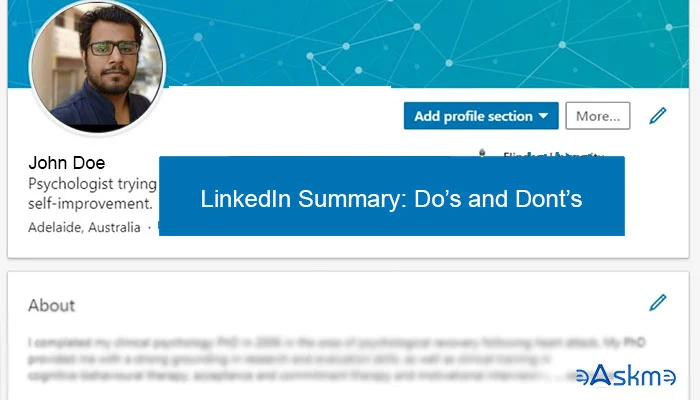
Need Help Writing Your LinkedIn Summary? 3 Dos & 3 Don'ts to Consider

A professional-looking profile photo and some relevant connections aren't enough for an effective LinkedIn page.

To get noticed by potential employers or clients, you need a comprehensive summary that tells visitors who you are, what you do and, most importantly, what you can do for them.

Need Help Writing Your LinkedIn Summary? 3 Dos & 3 Don'ts to Consider: eAskme


Need some help? Consider these three do's and three don'ts when filling out your LinkedIn profile:

1. Do provide all relevant work history:

Provide thorough, up-to-date descriptions of what you do currently and, if relevant, your work history so viewers can gauge your abilities.

LinkedIn gives you many ways to describe your time in a position, so take advantage of these tools.

And be honest: Let's say that you worked at a tech firm for three years, but only during your summer breaks. In that case, it's best to acknowledge that it was a summer internship.

There's no harm in including a long list of positions if you've held many.

For example, Michael Capiraso's extensive work history only strengthens his credibility as a seasoned executive in the sports, health and consumer products industries.

2. Don't give every detail of every job you've had:

Your work experience sections should give summaries of your most important responsibilities.

How you condense years of work into a paragraph or two is a matter not just of personal preference but of prioritization for your current career goals.

Using bullet points can help you condense and highlight critical responsibilities, and it also makes it easier for readers to digest.

Typically, you should accentuate your more recent and relevant positions and minimize your older and less-relevant positions.

For example, the fast-food gig you worked as a teenager should not be given prominence equal to your most recent, industry-related internship.

Full-time and long-held positions should also be prioritized over those temporary or part-time.

3. Do add credibility to your skill lists:

It's easy to list proficiency in five programming languages, forklift operation, and CPR, but it's another thing to prove it.

Fortunately, you can add credibility to the skills you've listed on LinkedIn by having your connections endorse them.

Work with C++ in your last position?

Maybe now is a good time to reach out to your previous coworkers or supervisors and ask them to endorse that skill on LinkedIn.

If you don't have ample experience using a skill in the workplace but still feel confident in your abilities, consider using LinkedIn skill assessments to prove your proficiency visibly.

4. Don't ask the wrong people for recommendations or endorsements:

Make sure the recommendations and endorsements on your profile come from reputable connections like your former supervisor or a client.

While your mom may think you're the best website designer ever to walk the earth, her endorsement on your LinkedIn page may look a little suspect.

Potential employers and clients know that it's easy to exaggerate one's abilities and get recommendations.

They'll scrutinize these, so make yours relevant and legitimate.

5. Do you have a substantial "About" section:

The "About" section of your LinkedIn is where you can provide context for all the experiences and skills you've listed in the other sections.

It's OK to discuss some of your work histories in this section since it's considered part of your bio.

Just emphasize your most pertinent roles and responsibilities — you don't have to repeat everything you've listed in your "Experience" section.

Your "About" section should give an accurate overview of your current status in the working world.

6. Don't forget about education:

If you're a younger member with little relevant work experience, it's OK to emphasize your college degree and academic achievements.

Depending on your goal, you may also want to list your GPA or specific classes or programs you took.

Education history shouldn't be prominently featured for older members with a more substantial work history.

Either way, it's essential to accurately represent formal education in your LinkedIn profile.

Have you received additional training or a certification recently?

Be sure to take advantage of LinkedIn's "licenses and certifications" section, making it easy to add and showcase credentials.

Just be aware that many certifications, such as Hubspot's Inbound Certification, clearly show an expiration date, so keep your current.

Conclusion:

A good LinkedIn summary should provide employers and clients with a comprehensive, detailed, and accurate representation of who you are and what you offer.

And who knows?

Taking the time to follow these three do's and three don'ts may land you that coveted position or land you a new client or two.

Still have any question, do share via comments.

Share this post with your friends and family.

Don't forget to join the eAskme newsletter to stay tuned with us.

Other handpicked guides for you;

Read More

2021/09/27

A+ Essays: Basic Requirements for Writing and Formatting

Essay writing often causes various difficulties, most often associated with the lack of knowledge of completing this type of assignment.

Thus, this overview will detail the basic requirements for writing and formatting a+ essays.

A+ Essays: Basic Requirements for Writing and Formatting: eAskme

The Specificity of Writing A+ Essay

A+ essay, like any other college student paper, should be built according to a specific structure.

The main components of the essay structure are as follows: introduction, main part, conclusions, references, applications (if necessary).

Introduction

The introduction is the essential content element of the essay, as it contains all the necessary classification characteristics:

  • Justification of the choice of topic
  • Assessment in terms of relevance and importance
  • Determining its place in existing scientific issues
  • Assessing the level and nature of topic development
  • Formulation of research goals and objectives

Main Part

The paragraphs should be presented sequentially.

In creating essays, you should explain the main provisions and give specific examples relating to the issue.

It is necessary to avoid repetitions and structure the text correctly to avoid grammatical, spelling, and syntactic errors.

It is also necessary to pay attention to the following tips:

  • The text of the essay should express opinions in an impersonal form;
  • When presenting different views, positions, views on the problem under study, citations of scientists should refer to the sources used;
  • It is essential to express your own opinion about the topic.

Conclusion

This section must summarize what is stated in the central part, the conclusions made according to the set tasks, or the reference to the methodological application of the material processed in the essay.

The author must also indicate the part of the essay that is his/her work.

Bibliography

The list of used sources should be placed in one of the following ways: in the order of references in the text (most convenient to use and recommended when writing the work), in alphabetical order of the first authors' names or titles, in chronological order.

Appendix

To avoid overloading the presentation of the primary material of the essay, the structural element "Appendix" contains material that complements or illustrates the paper, which:

  • Is necessary for the completeness of the essay, but its inclusion in the central part can change the orderly and logical idea of the work;
  • Cannot be placed sequentially in the main factor due to the large volume or methods of reproduction;
  • Can be removed for a wide range of readers but is necessary for professionals in a particular field.
  • Appendices are arranged in the order of reference in the text of the essay.

Where to Seek Help?

As you can see, writing a quality paper is not an easy task.

In this regard, many students decide to seek help in completing this assignment from a legit a+ essay writing service.

There you can hire a good helper and buy a paper at a low price.

The purchase process is simple and convenient, and all the client needs are to go through several stages:

  1. Decide on the choice of a website. There are a vast number of services on the Internet, so you are unlikely to have any problems with the search;
  2. Fill out the order form on an a+ paper writing service. It is essential to indicate what you expect from the writer and what kind of help you want to receive. Try to use the following fragment as an example: "I am looking for a professional helper who will write my papers on geography for me. I have a number of non standard requirements, so I want to entrust the writing of the paper to experienced writers. Since I am a student, I cannot pay much money and hope for an affordable or better even cheap price. Particular attention should be paid to timing. I want to get a fast execution, so I'm placing an urgent order. Thanks for the answer";
  3. Make a payment. Do not worry about the security of your private card data; the service guarantees that it will be kept confidential;
  4. Get the paper without plagiarism and receive the possibility of free edits during the warranty period.

So, now you know how to write an essay yourself and where to get online help if needed. Get started right now, and you will succeed!

The article's author works in an online essay writing service rated as the best and most secure today.

You can apply for support there and get top execution of any custom assignments (essay, research work, term paper, test work, dissertation, etc.).

Many clients confirm that only quality papers are put up for sale there!

Stay tuned with us to for more updates.

Don't forget to Join us on LinkedIn to stay tuned with us.

Share it with your friends and family.

Other Handpicked Guides for You;

Read More

2021/05/20

How to Write a Good Essay in High School

The demand on high school students to produce top-notch essays is ever-high today. They have to understand the topic, conduct research, and express their thoughts.

And with easy access to unlimited online resources, no high school student should be submitting poor essays.

How to Write a Good Essay in High School: eAskme

Other people are at: How to Make a Successful Website: 11 Critical Factors

But how can they get the best of these resources to write high-scoring essays?

This article shares proven tips to guide you on how to write a good essay in high school.

Beyond excellent school grades, this will help you gain a better understanding of essay writing concepts.

8 Tips on How to Write a Good Essay in High School

Students need to brace up for the challenges that high school education brings, especially in essay writing.

Here are writing tips to jazz up your high school essay!

1. Create an Essay Plan

Writing a good essay is like taking on a journey: you need a clear plan to take you where you are going. This planning usually starts by discerning the essay topic.

For example, before writing an expository essay, you need to start by brainstorming and highlighting points relevant to the essay topic.

From the information gathered, you can create an essay outline before you start writing.

This outline will give your essay a comprehensive and coherent structure.

2. Generate a Thesis Statement

Every good essay needs a central statement that coordinates the entire piece.

This statement highlights your paper's focus. Therefore, make the thesis clear and concise, especially for a cause effect essay.

3. Conduct Relevant Research

Creating an essay plan and writing your thesis statement will keep your research relevant to your essay writing.

Spend time gathering information and substantial evidence to support your claims.

Afterward, arrange all the qualitative vs quantitative data you discover for further analysis.

During your research, you need to establish relationships between different segments of your work.

This will help you organize them to develop the main body of your essay.

But since this is a high school essay, you may not need to conduct extensive research and experiments.

You can access relevant information in scholarly articles or the school library.

Ensure that your research findings are relevant to your essay.

4. Arrange Your Points Into Paragraphs

High school essays usually follow a 5-paragraph structure, including an introductory paragraph, three body paragraphs, and the conclusion.

Since you have obtained the information required to write the paper, it will be easier to break them down into sections.

Each paragraph should contain only one main idea and start with a topic sentence.

You should also include supporting evidence to bolster the main point.

And most importantly, organize your body paragraphs to create a seamless flow throughout the essay.

5. Begin With a Catchy Hook

Writing essay hooks is a vital aspect of writing excellent essays in high school. This technique is a perfect way to invite the reader to check out your work.

Therefore, you should begin with a relevant quote, statistic, or even a question.

Whichever opening you choose, make sure it is sharp enough to draw attention.

Besides, don't start your essay with a quote or statistic that is unrelated to the topic.

Double-check to confirm that the facts you select are accurate and valid.

6. Write Your Paragraphs

Begin each paragraph by stating its main idea in the topic sentence.

Consolidate the body paragraphs of your essay using research information, reference articles, examples, and supporting evidence.

However, don't use filler words to take up space in the body paragraphs. Instead, conduct better research to find out more information for your writing.

And most importantly, add in-text citations for borrowed knowledge.

7. Edit, Reread and Revise

After writing, you'll most likely end up with a first draft that will need some fine-tuning to get the essay going.

Don't rush to proofread: step away from your workspace and come back later to the paper with fresh eyes.

But if you are in an exam, you need to proofread immediately after writing your essay.

When editing, check for grammatical errors, restructure the paragraphs, and crosscheck the information in the text. You can also read the final draft aloud to hear how it sounds.

8. Practice More

Like every other activity, you can become better at essay writing by writing more essays!

Don't wait for history assignments or English tests to write an essay; practice as much as possible during your free time.

Moreover, you can consult past questions and select relevant essay prompts to study and write on your own.

You can also show your teacher the written essays for assessment.

Most teachers would be thrilled to read an unsolicited paper from their students!

Conclusion

Essay writing might appear twice as hard for high school students.

But with these tips, you can now write outstanding essays in high school and get excellent grades!

Don't forget to start with a plan when working on your papers.

And once the final draft is complete, proofread and get rid of errors.

If you still have any question, feel free to ask me via comments.

If you find this article interesting, don’t forget to share it with your friends and family.

Why?

Because, Sharing is Caring!

Don't forget to join the eAskme newsletter to stay tuned with us.

You May Also Like These;

Read More

2021/04/21

Essay Writing 101: Micro-Organization

In this article, we will simply take the ideas that we have been dealing with thus far and apply them on a smaller scale.

Instead of dealing with the body of an essay as a whole (i.e. macro-organization), the focus of this article will be on micro-organization.

Essay Writing 101: Micro-Organization: eAskme

Other people are at: Standard Essay Format: [Explained] Everything that You Must Know

Or, in other words, how to structure the paragraphs that support the macro-pattern of organization and the thesis statement.

Being clear about precisely what part of an essay is being discussed will be crucial.

Therefore, broaching this topic with clarity will require the introduction of some new terms.

According to essaywritingservice, the following sections will lay out the relationship between macro and micro methods of organization and the various ways in which they can interact.

Overview

Working from most general to most specific, the elements of an essay to be discussed here are:

  • Topic - Thesis - Macro-organization - Major Details - Topic Sentences - Micro-organization.

The two articles referred to the above deal with the first three terms.

As we have not used the term Major Detail (MD) yet, let's move directly to clarify what they are.

Major Details

MDs directly support the claims in the thesis and they are organized according to the macro-pattern of organization.

To support the thesis, they must be more specific.

For an example of this, let's return to the thesis for a process pattern used in the article on thesis statements.

  • Thesis: Several steps must be followed if gold is to be efficiently extracted and refined from the bedrock in South Africa's Witwatersrand region. So, the macro-pattern would be a progression of steps. In this case, the first MD (MD1) would read something like:
  • MD1: The first step in processing gold is to separate pieces of gold-containing rock from the bedrock.

Let's recap. Above we have a thesis, which clearly states the topic and the macro-pattern of organization.

We can also call these two elements by different names.

The thesis is a type of the Main Idea (MI) and the macro-organization pattern can also be referred to as a Major Pattern of Organization (MPO), which was dealt with in the article on macro-organization.

Main Ideas

Two types of MIs need to be distinguished. One we already know the thesis statement.

The other will become relevant now.

On a smaller scale, we can use the notion of MI about MDs. But an MD is not the main idea.

The main idea form of an MD is a topic sentence.

Topic Sentences

Just as the thesis sentence must contain a topic and pattern of organization, so too must the topic sentence.

The difference is the specificity of the information. A topic sentence will almost always be more specific than the thesis.

Otherwise, the thesis and topic sentence perform similar functions. That is, they both alert the reader of what is to follow.

The topic sentence just works on a smaller scale.

Let's continue our example to distinguish between MDs and topic sentences. Two possible topic sentences for MD1 used above would be:

  • Topic sentence 1: The first step in processing gold is to separate pieces of gold-containing rock from the bedrock. There are two common methods of doing this.
  • Topic sentence 2: Over the years, there have been two approaches often used to extract gold from bedrock in the Witwatersrand region.

Note the differences between the first and second examples.

The first example is more explicit than the second.

This has the benefit of making it very clear. It has a couple of problems though.

Firstly, it sounds stiff and, secondly, putting it in two sentences makes it a little clunky and inefficient.

In contrast, the second example has a little more flair than the first.

More importantly, though, it is more precise.

By introducing not only that there are two methods of extraction, but also that there is a historical dimension at work, the second topic sentence can impart more information on the topic with fewer words than the first.

Being an essay writer, I can say that Its shortcoming is that it does not mention that it is the first step in the mining process.

It is likely though that this would be inferred based on its location in the paper and the action it is describing.

In either case, the important point to note is that the micro-level pattern of the organization has been set up.

Micro-organization

In contrast to MPOs, of which there is typically only one in a paper, there will be many different minor patterns of organization (MPO) in an essay.

These MPO will be nestled within the MDs, which are organized around the MPO. It's a jumble of jargon, I know, but it is useful.

Let's continue to develop our example.

I'm going to use the second topic sentence example from above, as it does an overall better job of setting up the MPO.

  • Topic sentence: Over the years, there have been two approaches often used to extract gold from bedrock in the Witwatersrand region.

It seems as though there might be two MPO suggested.

The words, "Over the years" indicate that a time dimension is involved.

But, the presence of "two approaches" also indicates something.

They tell us that a list could be following. So which is it, a time or listing pattern?

In my opinion, the emphasis should be placed on listing the two types of extraction methods.

A writer must always remember their ultimate priority: to support the thesis.

So, if the thesis is describing a process of extraction, then listing the different methods to complete the first stage in the process is more important than when these methods were practiced.

That is not to say that the writer should ignore the historical dimension.

It would be an oversight to do so. However, in terms of organizing the information, it would best serve the essay to employ a listing pattern for this MPO.

But writing is not an exact science.

If a writer feels that they can justify another choice, if they believe a time order would best serve their argument, then by all means they should follow their instinct.

One more point should be clarified.

Just because a listing pattern was used as the MPO for the first MD, that does not mean that all subsequent MPO would also be listing.

In the following sub-section, a sustained example will demonstrate the variety of MPO that can be used throughout an essay.

Putting it all together (A sustained example)

We will continue the example used throughout this lesson and extended it through several stages of the essay's body.

This will demonstrate the extent to which different patterns of organization can be used to support one another.

Thesis: Several steps must be followed if gold is to be efficiently extracted and refined from the bedrock in South Africa's Witwatersrand region.

  • MPO: Process
  • MD1: The first step in processing gold is to separate pieces of gold-containing rock from the bedrock.
  • MD1's topic sentence: Over the years, there have been two approaches often used to extract gold from bedrock in the Witwatersrand region.
  • MD1's MPO: Listing
  • MD2: The second step in processing gold is to transport the excavated rock to the refining facility.
  • MD2's topic sentence: Transporting the unrefined, gold-infused bedrock to a refining facility is a major procedure.
  • MD2's MPO: Process
  • MD3: The third stage in gold processing is the refining process.
  • MD3's topic sentence: There are competing processes for refining, each of which bears some relation to one another.
  • MD3's MPO: Comparing and Contrasting

As you can see, MPO can be neatly stacked within the MPO in an article.

It is even possible to start stacking other patterns of organization within each MPO.

For instance, in MD3's MPO the author could describe each of the processes before noting in what ways they are similar and different.

Therefore, two process patterns could be nestled within the comparing and contrasting pattern.

How many paragraphs should be used?

I have avoided telling the reader how many paragraphs should be used to perform a particular task. I have done this for two reasons.

  1. First of all, determining how topics and paragraphs should be divided is a domain of creativity that should be left to each writer to decide.
  2. Second of all, it is impossible to say. Without having any knowledge of the details of a piece of writing, it would be inappropriate to dictate when and where paragraphs should be formed.

Use your best judgment. If a paragraph looks like it's getting too long for your comfort, then find a suitable place to divide it.

Pay attention to the pattern of organization at work in that paragraph. Find a point in the pattern that would benefit from having a new paragraph.

For instance, if you were listing something and the first point was running long, start a new paragraph on the second point.

Or, if the first two points are quite short, put them in one paragraph and the third point in a new one.

Conclusion

In this lesson, we covered how to use the major patterns of organization to complement one another in support of a thesis.

While only one sustained example was offered, the principles at work in it can be generalized to any piece of writing.

Paying attention to what you are trying to accomplish and how you are trying to accomplish it at every stage in an essay.

This is essential in crafting a sustained, coherent argument.

There are no rules in writing.

There is nothing that must be and there is nothing that must not be in any particular piece.

But some techniques can be employed to determine how to best approach a particular problem.

You can always be certain that your writing will benefit from being organized, clear, and to the point.

About the author: Timothy M. Wilson works as a content provider. He is interested in self-development and spiritual awakening. So he likes keeping up with modern tendencies of personal development. It helps him plan and have time to do everything.

If you still have any question, feel free to ask me via comments.

If you find this article interesting, don’t forget to share it with your friends and family.

Why?

Because, Sharing is Caring!

Don't forget to follow us on Twitter and join eAskme newsletter to stay tuned with us.

You May Also Like These;

Read More

2021/04/13

Standard Essay Format: [Explained] Everything that You Must Know

If you have a hand or know someone who does, you can learn the standard essay format.

While essays can be any length, a standard essay is usually five paragraphs arranged in a specific pattern that can be outlined on your hand. Being an essay writer, I can say that sometimes it is difficult to be bond to particular standards or rules. You can not feel relaxed and comfortable.

So I’m here to teach you.


Standard Essay Format: [Explained] Everthing that You Must Know: eAskme
Standard Essay Format: [Explained] Everything that You Must Know: eAskme

Other people are at: 7 Super Useful Tips on How to Deal With Too Much Homework

Raise your hand and let's get started!

What is An Essay?

An essay is an organized piece of writing that focuses on one theme or topic. 

In the old days essays were referred to as theme papers.

The Parts of an Standard Format Essay

An essay consists of three main parts which will be discussed in greater detail below.

  • The introduction
  • The body
  • The conclusion

The Introduction: First paragraph

The first paragraph of an essay is the introduction and it is represented by your thumb.

The introduction is the most important paragraph in the essay because it introduces the topic and carries the weight of keeping the reader interested long enough so he or she will read further.

Ideally, you want the reader to give your essay a thumbs up and keep reading.

An introductory paragraph must include a hook, something that will grab the reader's attention and make the person want to read more.

It should also include the thesis statement.

A thesis statement is a sentence that clearly states the main topic or focus of the essay.

A thesis statement is usually the final sentence of the introduction, though it can appear anywhere in the introductory paragraph.

The Body: Middle paragraphs

The body is the bulk of the essay.

In a standard essay, it consists of three paragraphs represented by your three middle fingers.

The body includes all of the details and information the writer wants to convey about the subject of the essay.

Each paragraph in the body should include a topic sentence that relates to the thesis statement or main focus of the essay.

The remainder of each paragraph will explain, support, and give details to support the topic sentence.

The Conclusion: Final paragraph

The last paragraph of the essay is the conclusion which is represented by the pinkie finger.

The conclusion ties the essay together so it is complete.

No new information is offered in the conclusion.

Instead, the thesis statement is restated in a new way and the reader is given a thought or question that will linger in the mind.

The essay writer online emphasizes that just as a hook grabs the reader's attention, the conclusion needs to offer something that will keep the reader thinking about the topic once he or she finishes reading the essay.

Hook the Reader: Grab the Reader's Attention

It's extremely important to grab the reader's attention at the beginning of the essay. Otherwise, the reader may not read any further.

This can be accomplished in several ways.

A question - Adding a question in the introduction forces the reader to get involved. A question begs for an answer.

Example: Have you ever eaten a chocolate-covered cricket?

A quote - A powerful quote can set the tone of the essay and spark interest in the reader.

Example: " A great deal of talent is lost to the world for want of a little courage." Sidney Smith

Action or dialogue - Jumping right into the middle of an activity or conversation creates energy and curiosity.

Example: "Stop right there!" the policeman yelled as he whipped out his gun.

An interesting fact - Immediately enlighten the reader and the reader will seek more enlightenment.

Example: The bacteria living in the average human body outnumber the body cells nearly ten to one.

Write a Solid Thesis Statement: Identify the Topic

The thesis statement clearly identifies the topic of the essay. It tells the reader where the essay is headed.

A thesis statement can be straightforward.

Example: Cats make fun pets.

A thesis statement can also be used to outline the topics of the three middle paragraphs in the body.

Example: Cats make fun pets because they are quirky, don't require much upkeep, and offer a lot of affection.

The most important thing to remember about the thesis statement is that it needs to be present. Don't forget it!

How to Remember the Standard Essay Format: Use Your Hand

People learn in different ways. Some learn by seeing, some by hearing, and others by doing.

These are some ways you can practice the standard essay format and commit it to memory.

Visual learners

Watch the video below that demonstrates how to use your hand to remember the standard essay format.

Read through this lens over and over until you feel like you comprehend the essay format.

Auditory learners

Listen to the information on the video below. Repeat the format aloud as you demonstrate with your hand.

Tactile learners

Watch the video below and copy the hand motions as many times as needed until you know the format.

Place your hand on paper and trace around it.

Label the parts of an essay on your drawing.

About the author: Bianca J. Ward used to be a divorce coach, but now she is a professional writer at EssayWriterFree where she provides people with qualitative works. Besides, she is a passionate photographer and traveler who has visited 52 countries all over the world. Bianca dreams about creating a photo exhibition to present her works to others.

If you still have any question, feel free to ask me via comments.

If you find this article interesting, don’t forget to share it with your friends and family.

Why?

Because, Sharing is Caring!

Don't forget to join eAskme newsletter to stay tuned with us.

You May Also Like These;

Read More
Grow Instagram Audience